Advantages
- Harnesses the muscle-brain axis, turning human muscle progenitor cells into a renewable source of brain-targeting therapeutic vesicles.
- Enables scalable, high-yield vesicle production in a compact bioreactor system.
- Uses a fully xeno-free process for safer, clinically ready, biocompatible manufacturing.
- Crosses the blood-brain barrier to deliver therapeutic cargo directly to affected neurons.
- Reduces neuroinflammation, amyloid buildup, and tau pathology through a single, multimodal disease-modifying action.
Summary
Alzheimer's disease is driven by multiple destructive pathways, including neuroinflammation, amyloid accumulation, and tau dysfunction. Yet most therapies address only one pathway and conventional drugs rarely reach the brain due to their inability to cross the blood–brain barrier. Extracellular vesicles are a promising vehicle for such therapy, but a manufacturing bottleneck holds them back from the clinic: producing them at scale, with batch-to-batch consistency and from a well-defined cell source, has proven difficult, limiting yield, reproducibility, and clinical translation.
This technology draws on the muscle–brain axis, the natural signaling route by which skeletal muscle sends regenerative cues to the brain. A xeno-free suspension process using mini-bioreactors manufactures therapeutic vesicles from a defined human muscle progenitor cell source at the consistency and quantities required by clinical use. The vesicles carry a cargo enriched in proteins that support metabolic resilience and proteostasis. In addition, the vesicles can cross the blood–brain barrier and deliver this cargo directly to the brain. This is a scalable approach that acts on multiple Alzheimer's pathways at once.
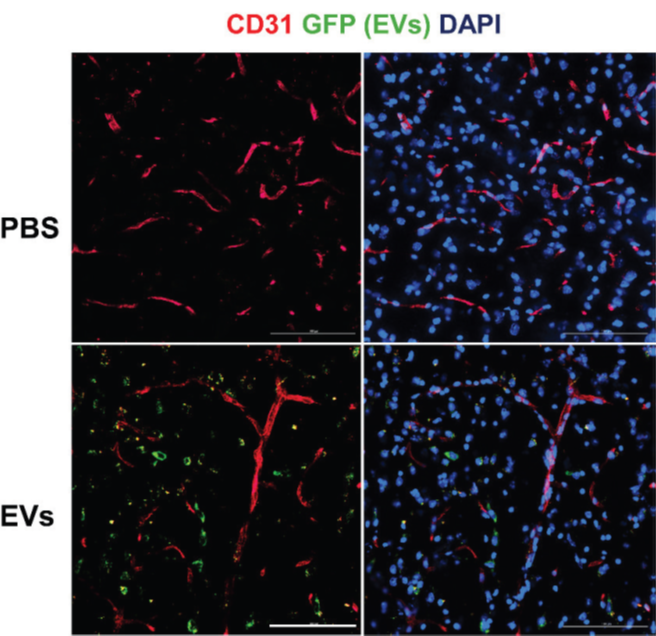
EVs from human muscle progenitor cells (MPC) across the BBB of 5XFAD mice.
Following systemic administration, extracellular vesicles (EVs) isolated from PalmGRET labeled MPC were detected beyond the brain capillary compartment.
Desired Partnerships
• License
• Sponsored Research
• Co-Development