Advantages
- Operates efficiently at room temperature, removing the need for extreme thermal environments.
- Reduces carbon dioxide emissions that are common in biological methane synthetic methods.
- Breaks down highly stable aromatic rings, solving a major chemical synthesis challenge.
- Supports both large-scale industrial production and localized on demand fuel generation.
Summary
Clean fuel production increasingly depends on efficient methane synthesis, yet current methods fall short. Fischer Tropsch processes demand extreme heat, pressure, and costly catalysts, while biological methods are slow, unscalable, and unstable. Breaking down persistent aromatic hydrocarbons into usable fuel remains a stubborn barrier, leaving industries without an economical, sustainable way to convert stable molecules into clean burning methane.
This technology takes a fundamentally different approach, using controlled quantum plasmonic effects within a gold nanocavity instead of bulk catalysts or intense heat. By precisely tuning nanoscale spacing and applying laser triggered electron tunneling, it breaks down a stable aromatic compound at room temperature, converting it into methane hydrate. Real time monitoring adds further reliability and control. The result is a precise, energy efficient process that opens new possibilities for clean fuel generation without the constraints of traditional synthesis methods.
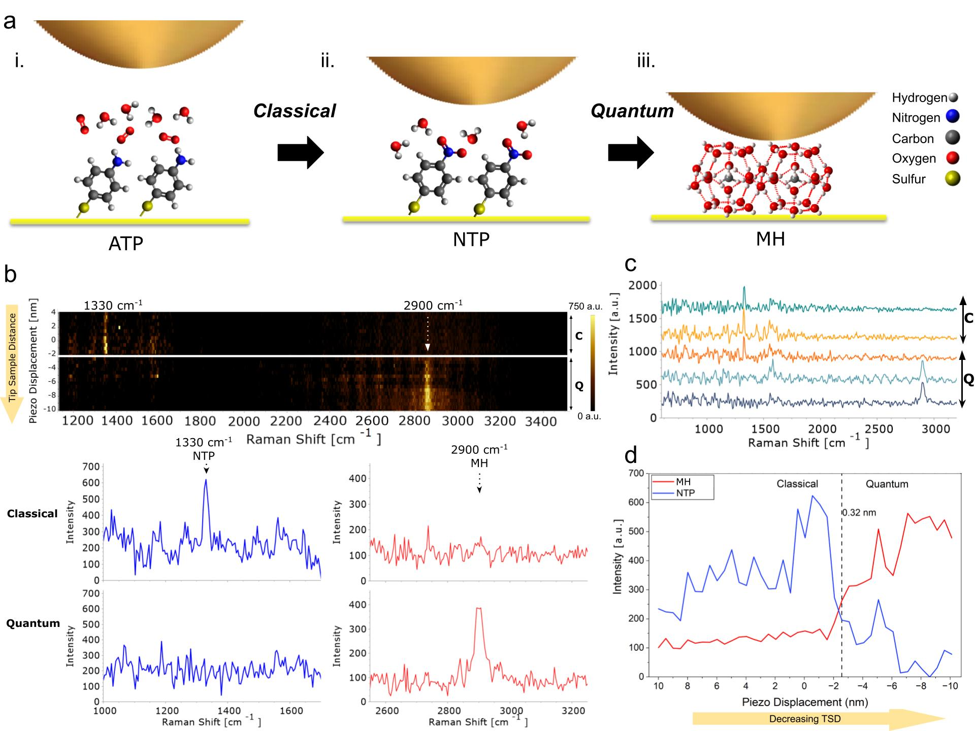
High-pressure quantum plasmonic conversion of ATP to MH during AFM nanoindentation under ambient conditions. (a) Schematic diagram of (i) ATP molecules on Au substrate in a classical nanocavity with large TSD > 20 nm, (ii) NTP molecules formed by the oxidation of ATP in a classical nanocavity with 20 nm > TSD > 1 nm, (iii) MH formed under local pressure in a quantum picocavity. (b) TSD dependence of the Raman spectra during the conversion from NTP (1330 cm-1) to MH (2900 cm-1). White solid line indicates the vdW contact that separates the classical (C) and quantum (Q) regimes. Insets show zoomed-in Raman spectra of NTP and MH in the classical and quantum regimes. (c) Raman spectra at different TSDs in the classical (dark blue, yellow), transition (red) and quantum plasmonic (light blue, black) regimes. (d) TSD profiles of integrated Raman intensity of NTP (blue) to MH (red).
Desired Partnerships
- License
- Sponsored Research
- Co-Development