Advantages
- Separates lithium from competing ions far more effectively than standard commercial membranes.
- Withstands harsh, hot, and highly concentrated conditions without breaking down over time.
- Scales easily for industrial production, supporting efficient, large scale lithium extraction operations.
- Adapts to other separation needs, including energy storage and water purification uses.
Summary
Global demand for high purity lithium is surging as battery and electronics industries scale up, forcing producers to extract lithium from complex brines and recycling streams where it is tightly mixed with sodium, potassium, and magnesium. Because these ions behave so similarly, separation is exceptionally difficult, and existing membranes degrade quickly in harsh, high temperature conditions, leaving a critical gap in durable, industrial scale lithium recovery technology.
This nanocomposite membrane combines graphene reinforced polymer construction with crown ether surface chemistry to selectively capture lithium while rejecting competing ions, achieving selectivity far beyond standard commercial membranes. Its scalable, lower solvent manufacturing process makes it practical for industrial deployment, while its adaptable surface chemistry allows the same platform to be tailored for other ion separation applications, offering both technical credibility and clear commercial value.
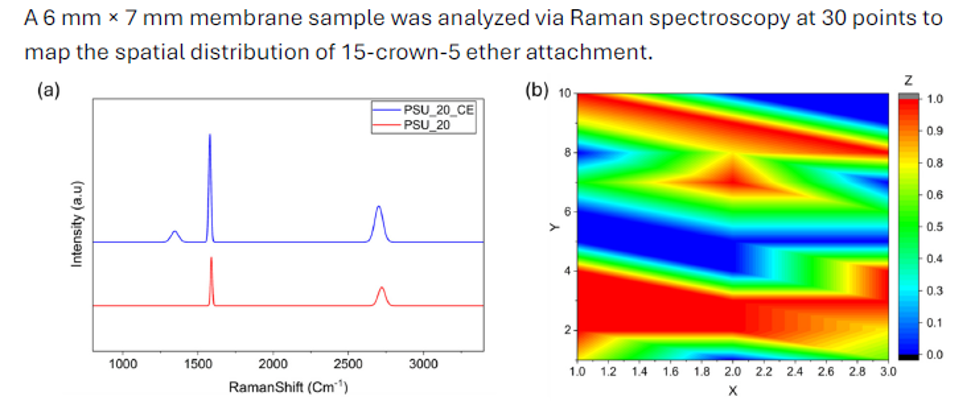
(a) Raman Spectroscopy of Fabricated Membrane (b) Contour plot illustrating the spatial variation in 15-crown-5 ether (15c5) attachment across the membrane.
Desired Partnerships
- License
- Sponsored Research
- Co-Development