Advantages
- Cuts production costs and speeds up prototyping compared to traditional semiconductor manufacturing methods.
- Unlocks complex three-dimensional sensor shapes that conventional fabrication techniques simply cannot produce.
- Delivers precise, customizable magnetic sensing that measures flux density from any direction.
- Enables smaller, simpler packaging by avoiding the bulky optics used in competing sensors.
Summary
Magnetic field sensors quietly power everything from phone compasses to automotive steering systems, with growing demand from medical diagnostics, robotics, and quantum computing. Yet manufacturers face a costly bottleneck: traditional semiconductor fabrication is slow, expensive, and locks devices into flat, two-dimensional designs. The market urgently needs sensors that are miniaturized, sensitive, affordable, and adaptable to space constrained, three-dimensional systems, a need current methods simply cannot satisfy.
This technology combines 3D printing with piezoelectric MEMS resonators, replacing the bulky optical readouts found in other 3D printed sensors with compact piezoelectric transduction. The result is a sensor that is easier to miniaturize and package while remaining simple and affordable to manufacture. Because additive manufacturing builds layered structures directly, it enables complex, non-planar geometries that conventional fabrication cannot achieve, offering a scalable, customizable alternative to existing Hall effect or SQUID sensors for demanding automotive, medical, and quantum applications.
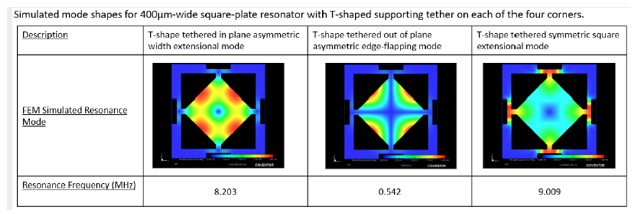
Simulated mode shapes and resonant frequencies of the proposed devices with Si and traditional method.
Desired Partnerships
- License
- Sponsored Research
- Co-Development