High-throughput testing platform that accurately mimics real-world activated carbon block filter hydraulics.
Advantages
- Generates predictive results that closely match full-scale carbon block filter performance
- Reduces development timelines, laboratory costs, and water consumption through efficient scale-down testing
- Enables high-throughput parallel experimentation within a compact laboratory footprint
- Modular and printable design makes scaling fast, simple, and cost effective
Summary
Safe drinking water depends on activated carbon block (ACB) filters, yet the tools available to evaluate their performance have not kept pace with innovation. Current testing methods typically require full-scale filter studies that consume substantial time, laboratory space, water, and financial resources. Unlike granular activated carbon systems, ACB filters lack a reliable small-scale testing equivalent capable of accurately predicting real-world performance. As a result, researchers, manufacturers, and certification laboratories must rely on costly and time-intensive studies that slow product development and delay new water treatment solutions
This novel filter cell technology provides the first practical approach for accurately downscaling activated carbon block filters while preserving the critical hydraulic behavior that governs performance. By replicating the true outside-in flow path and maintaining the same carbon thickness as a full-scale filter, the system generates results that closely reflect real-world operation. Its modular design supports high-throughput, parallel testing of contaminant removal, hydraulic residence time, biofilm development, and filter longevity within a compact laboratory footprint. The result is faster R&D, lower testing costs, and accelerated commercialization of next-generation water filtration products.
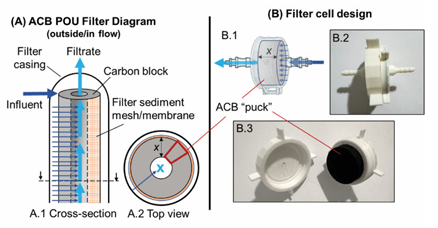
Schematic of the full-size ACB filter and the filter cell design, including top views and prototype photos.
Desired Partnerships:
- License
- Sponsored Research
- Co-Development