Advantages
- Single chip design enables compact and truly wearable glucose monitoring devices
- Detects very low glucose concentrations with high precision and reliable accuracy
- Ultra-low power draw significantly extends battery life in portable health monitors
- Robust sensor structure supports dependable reuse for up to fifty continuous days
Summary
Diabetes management depends on continuous, accurate blood glucose monitoring, yet the technology powering today's sensors is falling short. Current glucose biosensors suffer from limited electrode surface area, poor signal sensitivity, rapid degradation, and short lifespans. The electronic readout circuits compound these problems with high power consumption and excessive noise that masks critical low-concentration signals. Meanwhile, bulky discrete components make true wearable integration nearly impossible, leaving patients without the reliable, compact monitoring they need.
This integrated glucose sensing system addresses these gaps by combining a nanofibrous amperometric sensor with a CMOS potentiostat circuit on a single silicon chip. The electrospun nanofiber electrode coating dramatically increases surface area, enabling superior enzyme loading that translates into fast response times, a very low detection limit, and an operational lifespan of up to 50 days. The onboard CMOS circuit delivers high signal gain and ultra-low noise at just 225 µW, making the system well suited for discreet, long-lasting wearable glucose monitoring.
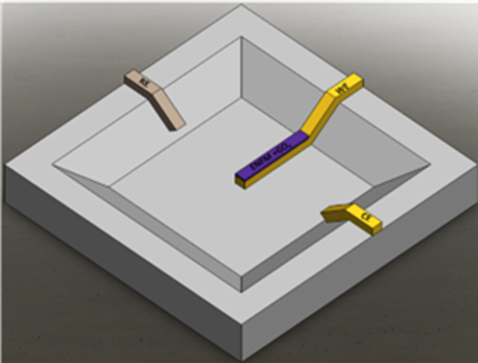
Top view of ENFM Glucose Sensor
Desired Partnership: