Advantages
- Achieves sub-ambient surface cooling under direct sunlight: Thick film nanocomposite coatings outperform leading commercial cool roof coatings by combining high solar reflectance with spectrally selective infrared emission through the 8–13 μm atmospheric window, enabling passive heat rejection to outer space without any energy input.
- Low-cost, scalable, and energy-efficient manufacturing: The novel non-pressurized, low-temperature, continuous-stir hydrothermal batch process eliminates the need for expensive autoclaves, nanoscale precision instrumentation, or complex multi-layer fabrication, making large-scale commercial production practical and affordable.
- Tunable cooling power for diverse climates and applications: Spectral selectivity and emissivity of the nanocomposite coating can be tuned by varying the doped nanoparticle chemistry, dopant concentrations, and binder medium enabling optimized performance for hot climates and minimized heating-load penalties in cold climates.
- Bridges the gap between advanced metamaterials and commercial paints: Uniquely combines the spectral performance of advanced radiative cooling metamaterials with the robust, easy-to-apply form factor of conventional roof coatings, using safe, low-toxicity chemicals (ZnO doped with SiO₂ and Si₃N₄) applicable via standard painting methods.
Summary
Global warming and the urban heat island effect are driving record peak air conditioning demands, escalating energy costs, and rising greenhouse gas emissions, yet existing solutions remain inadequate: conventional cool roof coatings lack the spectral selectivity to radiate heat efficiently to space, while advanced passive radiative cooling metamaterials rely on expensive nanoscale precision fabrication, pressurized autoclaves, or fragile multi-layer thin-film structures that are impractical for widespread commercial deployment.
This innovation, Spectrally Selective Doped ZnO Nanoparticle Passive Radiative Cooling Coatings, introduces a novel, non-pressurized, low-temperature, continuous-stir hydrothermal batch process to synthesize chemically doped zinc oxide semiconductor nanocrystals (using SiO₂ and Si₃N₄ dopants) that are randomly dispersed in a thick film nanocomposite and applied as a robust surface coating. Unlike existing approaches, this technology achieves near-ideal spectral selectivity by reflecting most of the solar radiation while strongly emitting infrared heat within the 8–13 μm atmospheric window, delivering measurable sub-ambient cooling even under direct daytime sunlight all through a simple, scalable, paint-like application. The technology is ideally suited for building and construction companies, commercial roofing manufacturers, HVAC and energy efficiency firms, cool roof coating producers, defense and aerospace thermal management providers, and smart city infrastructure developers. With its low manufacturing cost, tunable performance, and compatibility with standard application methods, this innovation is positioned for near-term licensing and commercialization as a next-generation passive cooling solution with global market potential across residential, commercial, industrial, and government sectors.
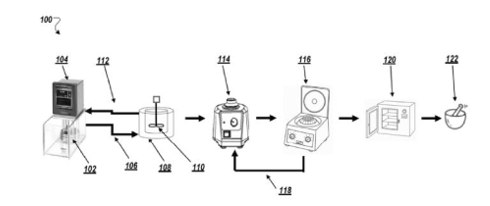
Hydrothermal Synthesis Apparatus & Process Flow
Schematic of the non-pressurized hydrothermal batch synthesis apparatus (US Patent 12492309B2, FIG. 1), showing the heated bath circulator, reactor beaker with magnetic stirrer, centrifuge, drying oven, and final nanoparticle grinding steps in the scalable manufacturing process.
Desired Partnerships
- License
- Sponsored Research
- Co-Development