Advantages
- Simultaneously detects magnetic and dielectric signals from core/shell nanoparticles with high sensitivity.
- Provides rapid, real-time biodetection in microfluidic systems using minimal sample volumes.
- Accurately differentiates healthy and cancer cells through enhanced signal responsiveness.
- Easily integrates into scalable biomedical and diagnostic devices while reducing overall testing cost.
Summary
Current biosensing technologies struggle to detect low-level biomarkers because traditional magnetic sensors lose sensitivity when nanoparticles are coated with non-magnetic shells like SiO₂. This limitation reduces accuracy in disease detection, increases assay time, and restricts real-time diagnostic capabilities - especially in microfluidic and point-of-care environments where speed and precision are critical.
The Magneto-LC Resonance (MLCR) sensor overcomes these constraints by simultaneously detecting magnetic and dielectric signals from core/shell nanoparticles, enabling highly sensitive, real-time biodetection even at low sample volumes. Its dual-signal resonance design improves diagnostic accuracy, differentiates healthy and cancer cells, reduces costs, and integrates seamlessly into microfluidic and biomedical platforms for scalable commercial applications.
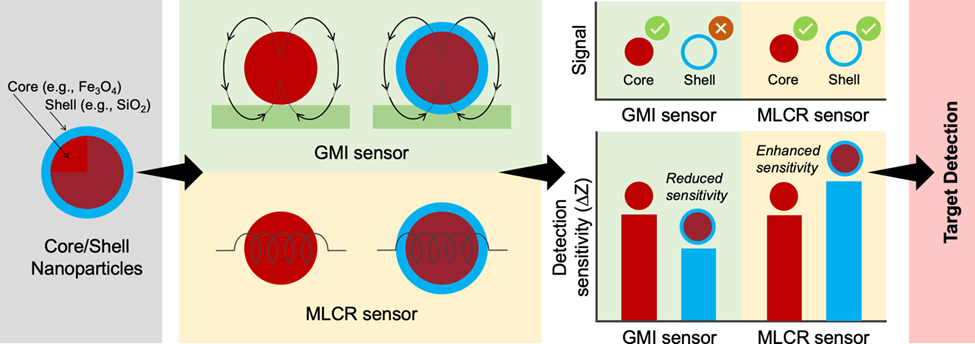
This figure shows the schematic comparing conventional GMI sensors and the magneto-LC resonance (MLCR) sensor. The MLCR design detects both magnetic and dielectric signals from core/shell nanoparticles, achieving enhanced sensitivity for biosensing and diagnostic applications.
Desired Partnerships
- License
- Sponsored Research
- Co-Development