A reusable biofilm carrier medium that captures ammonium from municipal wastewater and regenerates itself biologically — removing nitrogen without the salt brine that conventional ion exchange leaves behind.
Advantages:
- Faster nitrogen removal from wastewater
- No regeneration brine — eliminates the salt-waste stream and its disposal cost
- Reusable medium — capacity is restored biologically, in place
- Uses a natural zeolite — chabazite, an abundant, low-cost ion exchanger
- Fits existing biofilm reactors — carrier format suits standard designs
Summary:
Wastewater utilities face tightening effluent nitrogen limits, and the ammonium in mainstream municipal flows is costly to remove.
Conventional ion-exchange media capture ammonium effectively but must be regenerated with a concentrated salt solution, producing a
spent brine that is expensive to handle and dispose of — a recurring operating cost and a disposal liability..
This USF invention is a composite hydrogel carrier: a poly(vinyl alcohol)–sodium alginate medium that encapsulates chabazite, a natural
zeolite, formed into disks and spheres. Chabazite, a type of zeolite known for its high cation exchange capacity and cost-effectiveness, facilitates the ion exchange process by effectively adsorbing ammonium ions. The PVA-SA hydrogel creates an optimal environment for the growth of ammonium-oxidizing microorganisms (AOM), allowing continuous bioregeneration of the chabazite. In a single reactor this technology can remove ammonium (NH₄⁺) from mainstream municipal wastewater by ion exchange, then regenerate that capacity biologically through partial nitritation—anammox (PN/A) rather than with a chemical brine — a reusable, brine-free medium that couples ion exchange with biological regeneration. As evidenced in practice a single-stage IX—PN/A sequencing-batch biofilm reactor ran 12 —20 cycles over 250—500 days with PCR-confirmed anammox.
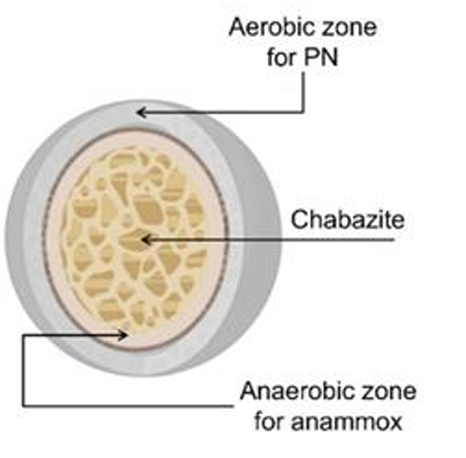
PVA-SA hydrogel carriers with integrated chabazite (PVA-SA-chabazite) for PN/A
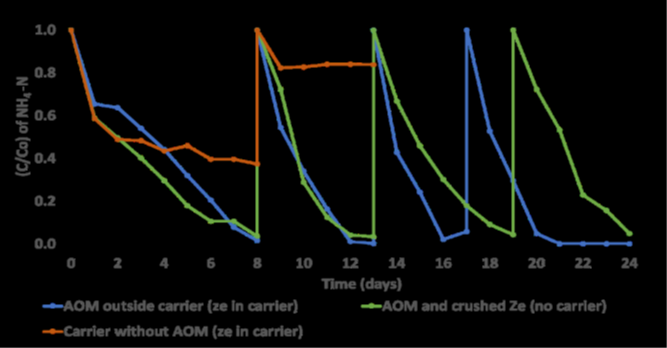
Comparison of ammonium removal in batch test
Desired Partnerships:
- License
- Sponsored Research
- Co-Development