Advantages:
- Delivers fast, highly accurate larvae identification without relying on scarce expert taxonomists
- Speeds detection of disease carrying mosquito species to strengthen public health surveillance
- Enables smarter vector control by automatically identifying sex and life stage
- Works with everyday smartphone photos, making advanced monitoring accessible to anyone
Summary:
Mosquitoes spread malaria, dengue, Zika, and other deadly diseases, making rapid species identification essential for outbreak control. Yet today's process depends on manual taxonomy, a slow, expert driven task that cannot keep pace with the volume of specimens collected during surveillance. This bottleneck delays public health responses and limits scalable monitoring worldwide.
This technology automates insect larvae classification using a Mask R CNN to segment anatomical regions and a dual branch bilinear neural network to analyze fine grained morphological detail, identifying genus, species, sex, and life stage. Unlike traditional approaches, it works directly on standard smartphone images, removing background interference and capturing subtle distinctions between closely related vectors. This combination of precision and accessibility makes it a practical, high throughput alternative to manual classification for surveillance and research applications.

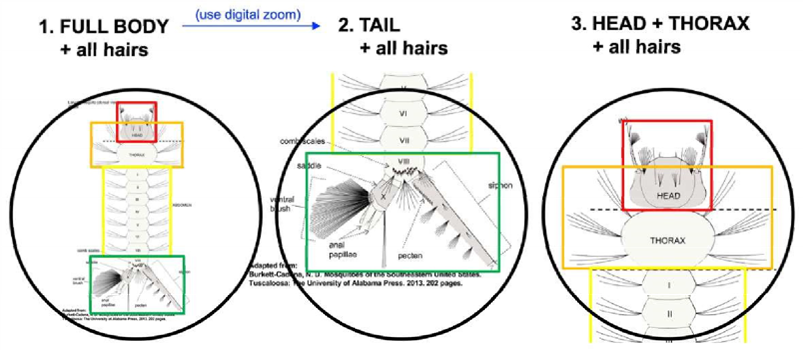
Figure 1: 2D geometric morphometric method, illustrating the setae-based landmarks (white dots) for the various anatomical regions (color-coded masks) of a mosquito larva.
Figure 2: Bounding box method for localization of individual anatomical regions.
Desired Partnerships:
- License
- Sponsored Research
- Co-Development